
Is your cat always climbing, jumping, or claiming the highest spot in the room? You are not alone. Cats naturally seek elevated spaces to observe, rest, and feel secure. A cat wall shelf turns unused vertical space into a fun, functional playground while keeping floors clear and your pet entertained. Whether you are building a single perch or a full climbing circuit, this guide shows you exactly how to make a safe, stylish, and cat-approved wall shelf system.
You will learn how to design a route that matches your cat is agility, choose the right materials, securely mount shelves on any wall type, and avoid common mistakes. From angled transitions around corners to rope-wrapped perches and doorway hammocks, every step is covered using proven techniques backed by real-world testing and feline behavior insights.
Plan Your Cat Climbing Route
Start Low and End High
Begin your wall shelf setup 12 to 14 inches off the ground so even cautious or older cats can hop on easily. This encourages exploration and builds confidence. Design the path to lead toward a reward zone such as a sunny window, cozy bed, or favorite human seating area. Cats are more likely to use shelves when they lead somewhere appealing.
Avoid placing the first shelf too high or isolated. If your cat will not jump on it, the whole system fails.
Space Shelves for Natural Jumps
Cats leap vertically and horizontally with precision. Match their natural ability with smart spacing.
Vertical distance: 12 to 18 inches between levels
Horizontal distance: 12 to 16 inches between shelves. Athletic cats can cross gaps up to 3.5 feet across doorways.
Adjust spacing based on your cat is age, energy level, and mobility. Arthritic or overweight cats need closer spacing than athletic young cats.
Pro Tip: Watch how your cat jumps around the house. Use that behavior to guide shelf placement.
Use Angled Shelves for Dynamic Paths
Install shelves at an angle to create visual interest and challenge. Angles up to 40 degrees from the floor are usable and safe for most cats. These work well as transition points around walls, balancing challenges for playful cats, and space-saving solutions in tight corners.
Ensure the surface has non-slip traction. Angled shelves must still offer secure footing.
Design a Continuous Path
Cats love to climb, observe, and return to safe zones. Build a looped or branching route that allows multiple ways up and down, resting spots every 2 to 3 shelves, and access to windows or social areas.
Include epic battle zones with awkward jumps or balancing acts for high-energy cats. These keep them mentally stimulated and physically active.
Match Design to Your Cat Needs
Adjust for Age and Mobility
Kittens and young cats benefit from faster routes, added scratching posts, and interactive elements like dangling toys.
Senior or stiff cats need shelves placed closer together, starting lower, and covered with carpeted or padded surfaces for comfort.
Overweight or arthritic cats should have limited access to high shelves. Use narrow steps or awkward jumps to keep them safe while lighter cats enjoy upper levels.
Consider Temperament
Curious cats love complex layouts with multiple pathways and choices.
Shy cats prefer semi-enclosed perches near walls or corners where they feel hidden.
Playful cats enjoy puzzle-like routes with bridges, hammocks, or suspended elements.
Support Multi-Cat Households
In homes with multiple cats, build overlapping routes so more than one cat can climb at once. Add alternative paths so dominant cats cannot block access. Use vertical space to reduce territorial tension. Each cat can claim their own level.
Real-World Example: One owner used small mini steps to prevent a heavy cat from reaching top shelves, giving lighter cats exclusive access to upper perches.
Install Shelves Around Corners, Doors, and Windows
Navigate Inside Corners
Corners are prime real estate for extending routes without using floor space.
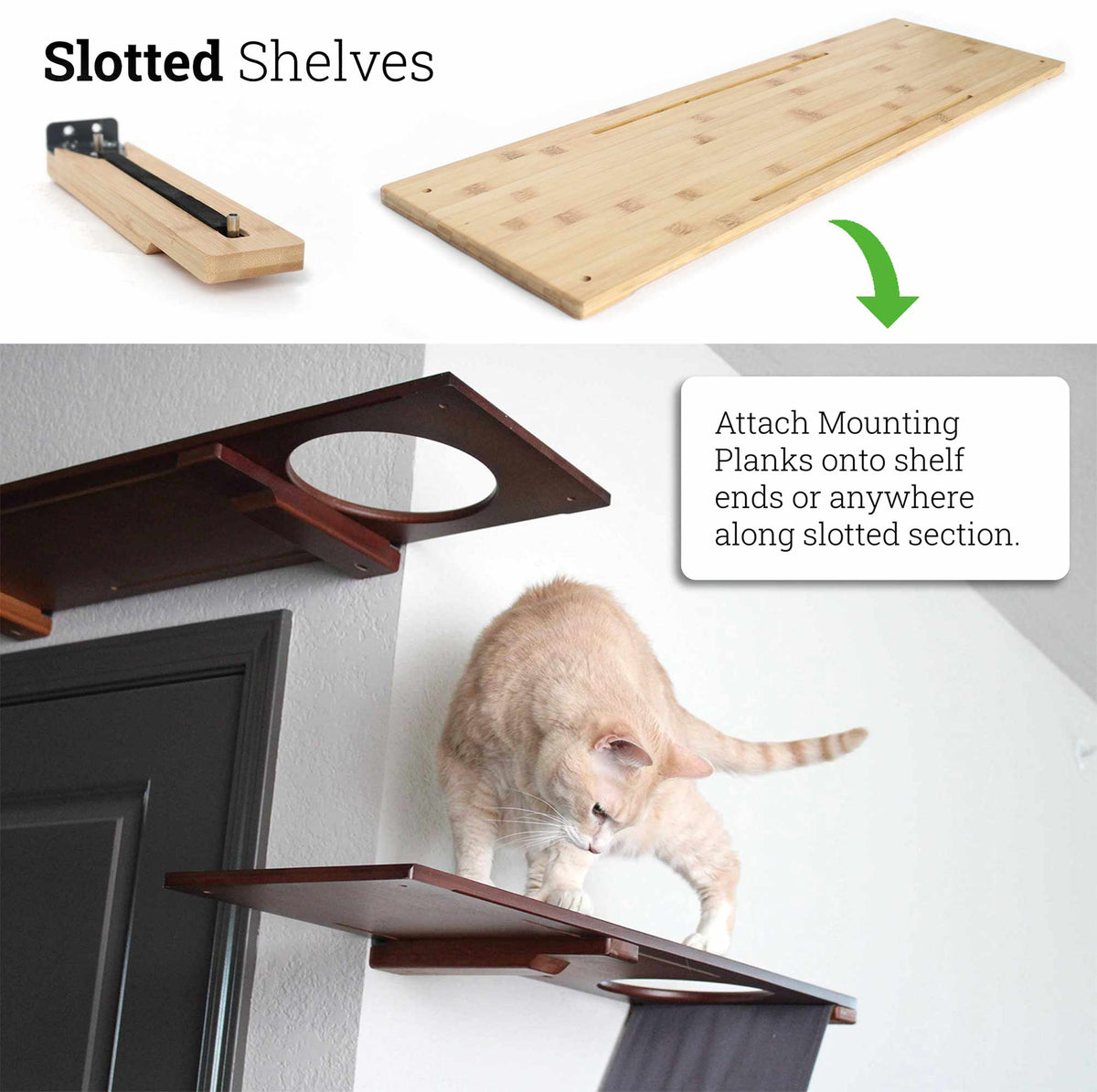
Use slotted cat shelves. These feature longitudinal slots that slide over mounting planks. They allow shelves to extend past the wall, enabling smooth 90-degree turns. Two planks can connect while maintaining structural support.
Try corner perch shelves. Mount these to a single central plank. They can be placed on wall edges to wrap around inside corners, ideal for tight spaces.
Install corner bridges. These are designed specifically for inside corners using 34-inch slotted shelves. They offer four layout options per section, great for custom configurations.
Build Over Doorways
Hammocks or shelves above doors create fun, interactive zones.
Step-by-step doorway installation:
- Find the stud near the door frame. Door frames are typically built with 2×4 lumber.
- Mount the first plank into the stud.
- On the opposite wall, install a second plank 0.75 inches lower.
- Attach fabric to the first plank, stretch it over the second, and clamp a third plank over the final grommet row.
- Pull tight, mark the bottom of the third plank, remove fabric, then reinstall the third plank at that height.
- Reattach fabric in reverse: fix to third, stretch over second, secure to first.
Note: Pre-sewn fabric kits simplify installation. For spans over 3 feet, use extended fabric.
Place Shelves Near Windows
Cats love watching outdoor activity. Install shelves 6 to 12 inches from windows for prime viewing.
Use reinforced brackets or suction cup mounts on sealed glass only. Avoid blocking window operation. Add soft padding because cats may lunge at birds or squirrels.
Pro Tip: Position a shelf under a window with a view of a bird feeder. Instant entertainment.
Choose Safe, Durable Materials
Pick the Right Wood
Use sturdy, dimensionally stable materials for the shelf base.
1×10 pine is readily available, easy to cut, and affordable.
Plywood at 3/4 inch thick is strong and flat, resisting warping.
Composite board is moisture-resistant, great for humid areas.
Time-Saver: Ask your hardware store to cut wood to size. Many offer free cuts.
Shelf dimensions: Minimum width should be 10 inches so cats can turn comfortably. Standard length is 24 inches, fitting between 16-inch studs. Custom lengths adjust based on wall layout and stud positions.
Add Traction with Surface Coverings
Bare wood is slippery. Cover the top with grippy, comfortable materials.
Carpet is soft, warm, and provides excellent traction. Use remnants or old rugs to save money.
Doormat made of coir or synthetic material is durable and scratch-resistant, ideal for high-traffic zones.
How to apply: Use spray adhesive like 3M Super 77. Glue material only to the top surface. This prevents wrinkles and tripping hazards. Staple edges only on sides and underside. Wrapping material around edges gives cats something to grip when climbing.
Finish Tip: After stapling, trim excess and fold flaps neatly for a clean look.
Mount Shelves Securely on Any Wall
Anchor Into Studs or Solid Surfaces
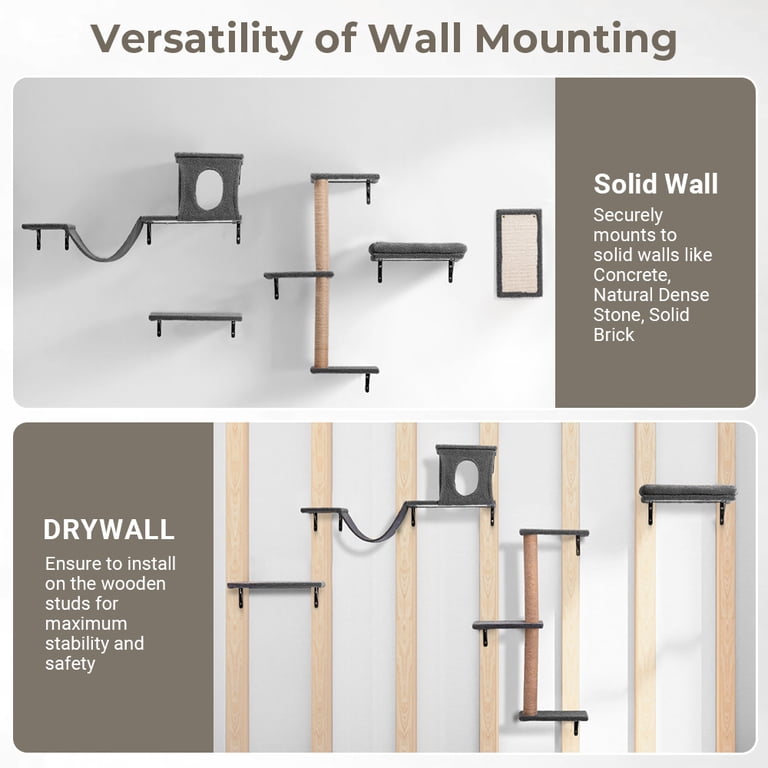
Never rely on drywall alone. Cats generate dynamic loads when jumping or landing. Always secure at least one mounting point per shelf into wall studs, concrete, brick, or solid masonry.
Tools you will need: Stud finder, level, drill, screwdriver, and measuring tape.
Install on Drywall Safely
Best method: Use studs with L-brackets. Attach heavy-duty L-brackets rated for 80 pounds or more to the shelf. Secure brackets to the wall with long screws driven into studs spaced 16 or 24 inches apart. Use pan-head screws to connect shelf to bracket.
No stud available? Use toggle bolts. These expand behind drywall with approximately 2-inch flange to distribute weight. They support heavy loads when properly installed. Avoid plastic anchors or screw-in types. They fail under stress.
Mount on Brick or Concrete
Use masonry-specific anchors including hammer-in anchors, sleeve anchors, or wedge anchors.
Requirements: Masonry drill bit and impact driver. Match anchor size to bolt diameter.
Secure to Cinder Block
Use masonry anchors if drilling into solid sections. Alternatively, insert toggle bolts into hollow cavities. They expand inside for a strong hold.
Build Rope-Wrapped PVC Perches
Why Use PVC Shelves
PVC shelves are lightweight yet strong. They feature hidden screws for a clean look. They are customizable with colored rope. The scratch-resistant surface attracts cats.
Step-by-Step Assembly
- Cut PVC pipe to desired length. Six inches or 12 inches are common. Sand edges smooth.
- Drill a centered hole in two PVC end caps.
- Locate a stud, drill pilot hole, and insert lag screw through cap.
- Loop pet-safe rope around cap, tighten bolt to clamp rope.
- Cut cardboard circle to match pipe outer diameter approximately 2 inches.
- Punch off-center hole in cardboard for visual balance.
- Apply hot glue to rope end, thread through cardboard, set briefly.
- Glue perimeter of PVC, press cardboard onto pipe. This creates a base for wrapping.
- Wrap rope tightly around pipe. Twist slightly as you go to maintain tension. Apply hot glue every half-wrap, especially in high-use areas. Finish with a full glue bead around the outer edge.
- Use a spare cap as a template. Insert pipe, mark where rope should stop. Cut rope at a slight angle to reduce fraying. Seal end with hot glue.
- Insert pipe into cap, drill two pilot holes through cap side into pipe.
- Insert screws. They stay hidden under the rope.
- Final wrap covers the cap, trim excess, seal with glue.
Bonus: These can be combined into a full wall tree. Add hammocks or bridges for variety.
Add Comfort and Safety Features
Install Soft Landing Zones
If shelves are above hard floors, place rugs or cushions below. Avoid positioning shelves over sharp or breakable objects. Limit height for older or less agile cats.
Block Unwanted Access
Keep heavier or less mobile cats off high shelves using fabric walls to block access to TVs or restricted areas. Use awkward jumps such as angled sisal post with a hole to jump through, mini steps too narrow for large cats, or angled routes requiring balance and precision.
Example: A heavy cat named Bronson was kept off upper shelves using mini steps. Lighter cats now dominate the high ground.
Use Positive Reinforcement
Introduce shelves gradually. Place treats, toys, or catnip on each level. Praise your cat when they use the shelf. Let them explore at their own pace.
Most cats adapt within days if the path starts low and leads somewhere rewarding.
Ensure Long-Term Safety and Durability
Test Load Capacity
Each shelf must handle dynamic loads from jumping, running, and landing. Minimum rating should be 80 pounds per shelf. Test by pressing down firmly with your hand. There should be no wobbling or shifting. Recheck screws and anchors every 3 to 6 months.
Maintain Your System
Vacuum or shake out carpeted shelves monthly. Inspect hot glue on rope perches. Reapply every 1 to 2 years if needed. Tighten screws annually, especially in high-traffic areas.
Real Feedback: Users report carpeted wood shelves lasting several years. Rope-PVC perches hold up to daily scratching and lounging.
Match Style to Your Home Decor
Choose a Design Theme
Rustic features natural wood with jute rope wrapping.
Modern uses painted MDF with neutral carpet.
Minimalist creates floating shelf look using hidden brackets.
Playful incorporates bright rope colors or patterned fabric pads.
Blend with Your Room
Stain or paint shelves to match furniture or trim. Use low-profile brackets for a discreet look. Align shelf heights with artwork or shelves for cohesion.
Frequently Asked Questions About Cat Wall Shelves
Do cat shelves need to be in studs?
Yes. At least one mounting point per shelf must be in a stud, concrete, brick, or solid masonry. Drywall-only anchors are not safe for jumping cats.
What is the best shelf spacing?
Vertical spacing should be 12 to 18 inches. Horizontal spacing should be 12 to 16 inches, up to 3.5 feet for athletic cats. Always consider your cat size and agility.
Are cat wall shelves safe?
Yes, if securely anchored. Risk depends on installation quality, cat mobility, and surrounding hazards. Add soft landings for less graceful jumpers.
How do you make a cat wall tree?
Combine multiple shelves, bridges, hammocks, and perches into a continuous system. Use modular designs like rope-PVC or slotted shelves for flexible layouts.
What materials should I use?
Base materials include 1×10 pine, 3/4-inch plywood, or composite at minimum 10-inch width. Use carpet or doormat for covering. Apply 3M Super 77 spray adhesive. Mount with L-brackets and lag screws or toggle bolts.
Can I install on concrete or brick?
Yes. Use masonry anchors including hammer-in, sleeve, or wedge types with a masonry bit and impact driver.
How do I keep dogs off cat shelves?
Use awkward jumps with small steps or angled posts. Install fabric barriers. Place shelves too high or narrow for dogs.
Key Takeaways for Building Cat Wall Shelves
A well-built cat wall shelf enhances your pet environment, reduces boredom, and strengthens your bond. By following these guidelines, you will create a system that is safe, functional, and irresistible to your cat.
Start low at 12 to 14 inches from the ground. Space shelves 12 to 18 inches vertically and 12 to 16 inches horizontally. Always anchor into studs, concrete, brick, or solid masonry. Use heavy-duty L-brackets rated for 80 pounds or more.
Choose durable materials like 1×10 pine or 3/4-inch plywood. Add carpet or doormat for traction. Apply spray adhesive only to top surfaces.
Build continuous paths with resting spots every few shelves. Consider your cat age, mobility, and temperament. Add positive reinforcement during introduction.
Whether you build one shelf or a full wall circuit, you are giving your feline a kingdom they will love to rule.