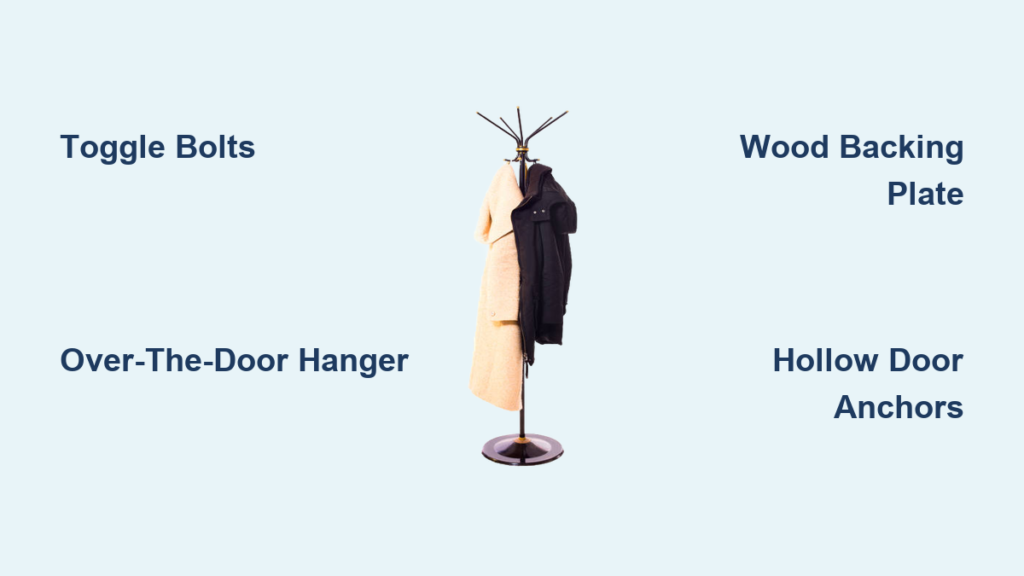
If you’ve tried screwing a coat rack directly into a hollow core door only to watch it pull out under the weight of a single jacket, you’re not alone. Hollow doors have thin outer skins and minimal internal structure, making standard screws ineffective. The good news is that with the right technique, you can securely mount a coat rack without damaging your door or leaving ugly holes.
This guide covers the most effective mounting methods for hollow doors, from renter-friendly options to permanent solutions. You’ll learn which hardware to use, where to mount for maximum strength, and how to avoid common mistakes that lead to failed installations.
Choose the Right Mounting Method for Your Hollow Door
Hollow doors require specialized mounting techniques because standard screws cannot hold in the thin 1/8-inch hardboard skin. The best method depends on your load needs, how long you need the installation to last, and whether you can modify the door.
Toggle Bolts for Permanent Installations
Toggle bolts are the strongest permanent option for hollow doors. These anchors expand behind the thin door skin, distributing weight across a wide area. The Toggler Snaptoggle is particularly recommended because it adjusts for material thickness and offers high pull-out resistance. Load capacity reaches 25 to 50 pounds when properly installed.
Over-the-Door Hangers for No Damage
A metal wreath hanger drapes over the top edge of the door, using the solid top rail as the anchor point. This method requires no drilling and leaves no permanent damage, making it ideal for renters. These hangers support 20 to 40 pounds when used with the solid top rail.
Wood Backing Plate for Medium Loads
Glue a solid wood block to the door surface first, then mount your rack into the block. This creates a real anchor point in an otherwise hollow surface. A 3/4-inch thick block sized at least 4 by 6 inches provides holding power for 15 to 30 pounds after the adhesive cures for 24 hours.
Specialty Hollow Door Anchors for Quick Installations
Products like Easy Anchor or Plasplugs drive in like screws but expand behind the door skin. They offer a faster alternative to toggle bolts while still providing decent holding power. Most specialty anchors support 10 to 40 pounds per anchor.
Adhesive Hooks for Temporary Use
Command-style adhesive strips work for very light loads up to 10 pounds. These require no drilling and remove cleanly, but they fail quickly on glossy surfaces or in humid bathrooms.
Install Toggle Bolts for Permanent Mounting

Toggle bolts work by spreading force behind the fragile door skin, preventing pull-out. They are the go-to solution for secure, long-term installations.
Steps for Installing Toggler Snaptoggle Anchors
- Mark and level the rack position. Avoid the center panel and aim near the top or side stiles where the door structure is stronger.
- Drill a 1/2-inch hole through the door using a brad-point or Forstner bit for clean edges. Use a piece of tape on the drill bit to mark depth and prevent accidentally drilling through the other side.
- Insert the folded toggle through the hole, then release so the wings open behind the inner skin.
- Slide the rack or bracket over the bolt, add a washer, and tighten the nut until snug.
- Trim excess bolt if needed to prevent interference when the door closes.
Pro Tip: Use a piece of tape on the drill bit to mark depth. This prevents accidental breakthrough through the opposite door skin.
Avoid molly bolts. They don’t expand wide enough in hollow doors and offer less holding power than toggle-style anchors.
Use Over-the-Door Hangers for No-Damage Installation
No drilling is required when you use a metal over-the-door wreath hanger. These devices use the door’s strongest part, the solid top rail, as their anchor point.
Steps for Installing a Wreath Hook
- Choose a sturdy brass or chrome hanger with rubber padding to prevent scratches on the door edge.
- Drape the hanger over the top edge of the door. Ensure it clears the trim when the door is closed.
- Adjust the arm length if your model allows to set the rack at your preferred height.
- Hang your coat rack or organizer from the downward-facing hook.
These hangers support up to 40 pounds, which is enough for robes, scarves, and light bags. This is the best method for renters or anyone who wants a fully removable installation with zero damage.
Reinforce with a Wood Backing Plate
When you need more strength than anchors provide alone, gluing a solid wood block behind the mounting area creates a real base for screws to grip.
Steps for Applying a Wood Backing Plate
- Sand the door surface where the block will go. This removes the finish and improves adhesive adhesion.
- Clean the area with rubbing alcohol to remove dust and oils.
- Apply construction adhesive like PL Premium or Liquid Nails to the back of a 4-inch by 6-inch wood block that is 3/4 inch thick.
- Press the block firmly into place and clamp if possible. Let it cure for 24 hours before mounting.
- Pre-drill pilot holes in the block, then mount the rack with 1 1/4-inch to 2-inch wood screws.
Warning: Measure door-to-jamb clearance before gluing. Adding thickness to the door may prevent it from closing properly.
An alternative approach is to glue a large wooden knob to the door first, then screw the hook into the knob. This increases surface contact and prevents pull-through.
Try Specialty Hollow Door Anchors

Self-expanding hollow door anchors like Easy Anchor offer a faster, cleaner alternative to toggle bolts while still providing reliable holding power.
Steps for Installing Easy Anchor Fasteners
- Drill a pilot hole slightly smaller than the anchor. Follow the package specifications for the correct size.
- Insert the anchor with a hand screwdriver. Do not overtighten during this step.
- Drive the rack screw into the anchor until the internal mechanism pops open behind the skin.
- Tighten gently. The mechanism locks into place once secured.
These anchors hold up to 40 pounds per anchor and finish flush with no protruding bolts. They are best for light to medium racks when you want a clean look without the bulk of toggle bolts.
Avoid plastic anchors rated under 10 pounds. They fail under repeated stress and are not suitable for coat racks.
Apply Adhesive Hooks for Temporary Solutions
Renters or those avoiding any door modification can use heavy-duty adhesive hooks, but only under the right conditions.
Steps for Applying Command-Style Strips Correctly
- Clean the door surface with alcohol. Remove all dust, oil, and residue that could compromise adhesion.
- Peel the backing and press the adhesive strip firmly for 30 seconds.
- Wait 1 hour before attaching the hook or rack. This allows the adhesive to set properly.
- Limit load to 10 pounds maximum. Use only for coats, hats, or scarves.
Avoid adhesive hooks on glossy or textured surfaces. Adhesion fails quickly in humid areas like bathrooms. These are best for temporary or ultra-light use only.
Avoid These Weak Mounting Methods
Some popular shortcuts simply don’t work on hollow doors. Here’s what to skip entirely.
Standard Wood Screws
They only bite into 1/8 inch of hardboard. These pull out under minimal weight even when you pre-drill pilot holes. This is the most common mistake and guaranteed to fail.
Over-the-Door Plastic Hangers
Cheap plastic hangers slip, crack, or damage the door edge over time. Maximum load is around 5 pounds, making them useless for daily coat storage.
Adhesive in Humid Areas
Unless the product is specifically rated for moisture, bathroom installations will fail quickly. Humidity breaks down the adhesive bond.
Position Your Coat Rack Correctly
Where you mount matters as much as the hardware you choose. Hollow doors have stronger and weaker areas.
Best Mounting Locations
Mount in the top third of the door, which is closest to the solid top rail and more stable. Position near vertical edges where proximity to side stiles adds rigidity. Avoid center panels entirely, as this is the weakest area and prone to cracking.
Installation Tips
Use a bubble level to ensure your rack hangs straight. Mark both holes before drilling. Check that the rack doesn’t hit the wall when the door opens. Use painter’s tape on the drill bit to mark depth and prevent drilling through the other side.
Maintain Your Mount Over Time
A secure mount today can loosen tomorrow. Regular inspection prevents sudden failures.
Warning Signs to Watch For
Loose screws or a wobbling rack indicate anchoring failure. Cracks around mounting holes mean the door skin is stressed. A sagging or tilting fixture suggests uneven load distribution. Corrosion appears in bathrooms and weakens metal hardware.
Maintenance Tip: Re-tighten toggle bolts every 6 months. Avoid hanging bags by their straps, as this creates shear stress that weakens anchors over time.
Frequently Asked Questions About Mounting on Hollow Doors
Can I use regular screws to mount a coat rack on a hollow door?
No. Standard wood screws only engage 1/8 inch of hardboard and pull out under minimal weight. Use toggle bolts, hollow door anchors, or over-the-door hangers instead.
How much weight can a hollow door hold?
It depends on the method. Toggle bolts support 25 to 50 pounds. Over-the-door wreath hangers handle 20 to 40 pounds. Specialty anchors like Easy Anchor hold up to 40 pounds. Adhesive hooks are limited to 10 pounds or less.
What is the strongest mounting method for hollow doors?
Internal wood insertion provides the highest strength at 50 pounds or more, but it’s the most invasive. For most users, toggle bolts with the Toggler Snaptoggle offer the best balance of strength and ease.
Can I mount a coat rack on a hollow bedroom door without damaging it?
Yes. Use an over-the-door wreath hanger for zero damage, or use specialty hollow door anchors which leave small holes that are easily filled if needed.
Do over-the-door coat racks work on all doors?
They work best on standard interior doors with a solid top rail. The door must have enough clearance above the opening for the hanger to fit without hitting the trim.
How do I know if my door is hollow core?
Knock on it. A hollow, echoing sound indicates a hollow core door. A solid thud suggests a solid wood or composite core. Hollow doors are also significantly lighter than solid doors.
Key Takeaways for Mounting Coat Racks on Hollow Doors

Mounting a coat rack on a hollow door requires matching your method to your specific needs. Over-the-door wreath hangers offer the easiest solution for renters or temporary use with zero damage. Toggle bolts provide permanent holding power for moderate to heavy loads. Wood backing plates create medium-duty strength for long-term installations. Specialty anchors offer a fast middle-ground option.
Always mount near the top rail or side stiles, never in the weak center panel. Use a level during installation and check door clearance before committing to any permanent method. Inspect your installation every few months to catch loosening before it becomes a problem.
With the right approach, your coat rack will stay secure, your door will remain intact, and your coats will hang safely where you need them.