If you’re managing a warehouse, distribution center, or industrial storage facility, selecting the right pallet rack types is critical to maximizing space, efficiency, and safety. With so many configurations available, each designed for different inventory profiles, access needs, and operational demands, it is easy to feel overwhelmed. Understanding your core options transforms this complex decision into a strategic advantage.
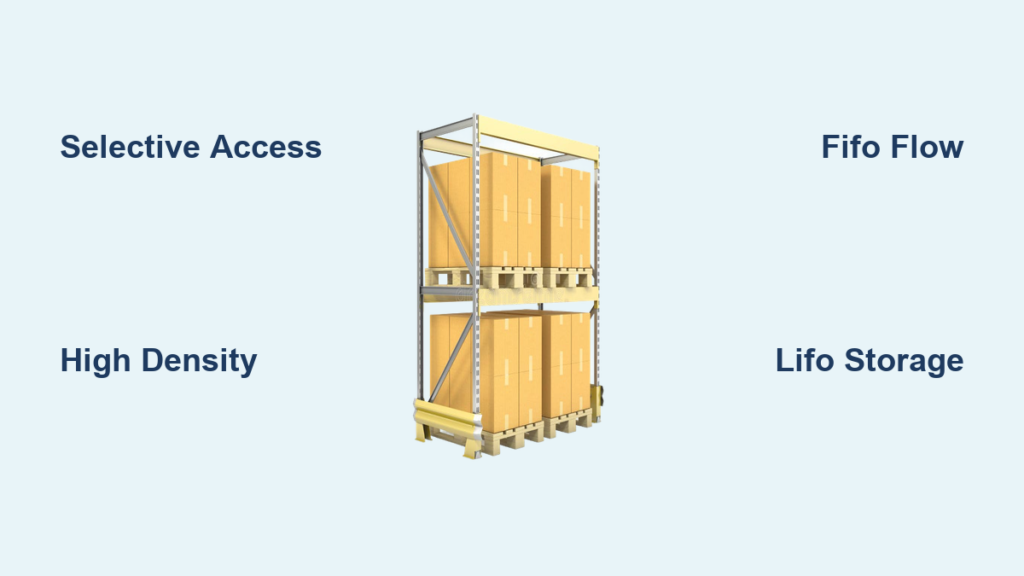
Pallet racking systems store unitized loads on pallets across multiple levels, enabling vertical space utilization and efficient forklift access. They fall into two main categories: selective systems, which prioritize full access to every pallet, and high-density systems, which maximize storage capacity by reducing aisle space. The right choice depends on your SKU count, turnover rate, available floor space, budget, and inventory flow requirements.
In this guide, you will learn how each major pallet rack type works, its pros and cons, ideal use cases, and key specifications. You will also discover how to identify existing racking, avoid compatibility issues, and maintain long-term safety and performance.
Selective Pallet Racking
The most common and flexible system in warehousing, selective racking offers direct access to every pallet position without moving others.
Why Choose Selective Racking
Selective pallet racking is the industry standard for general storage due to its simplicity, affordability, and adaptability. It consists of upright frames connected by horizontal load beams, forming single-depth bays where each pallet is immediately accessible. This system functions like industrial shelving, ideal when accessibility trumps density. Beam heights are adjustable in 2 to 3 inch increments, allowing reconfiguration as inventory needs change.
Key Features and Specs
Selective racking offers several construction and configuration options to match different operational needs.
Load capacity ranges from 2,000 to 10,000 lbs per beam level, depending on beam gauge and upright strength.
Construction materials include roll-formed steel for economical applications, structural steel for superior durability, or hybrid configurations that combine both.
Decking options include wire mesh for airflow and fall protection, solid steel for heavy loads, or carton flow lanes for dynamic picking.
Finish types range from powder-coated for standard indoor use to epoxy for enhanced protection, or galvanized for freezers and outdoor environments.
With 100% selectivity, this system supports FIFO inventory rotation, making it ideal for operations requiring frequent stock rotation.
Advantages and Limitations
Selective racking delivers several distinct benefits alongside some inherent constraints.
Advantages include:
Full access to every pallet without moving others
Low initial investment compared to high-density systems
Easy to assemble, modify, and expand as needs change
Compatible with all standard forklifts and reach trucks
Widely available components from multiple manufacturers
Limitations include:
Lower storage density due to wide aisles required for forklift access
More floor space needed than high-density alternatives
Uprights are vulnerable to forklift damage in high-traffic areas
Selective racking works best for warehouses with diverse SKUs, general manufacturing, retail distribution, and facilities prioritizing flexibility over space savings.
Double Deep Racking
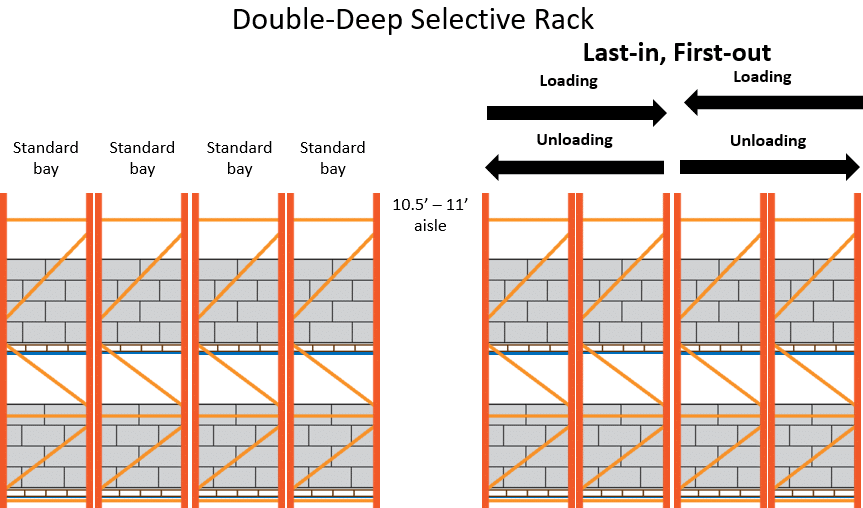
Double deep racking doubles storage density by storing two pallets deep per lane, offering a middle ground between selective access and maximum density.
How It Increases Storage Efficiency
By extending bays from single-depth to two pallets deep, double deep racking reduces the number of aisles by up to 50%. This increases storage density by 40 to 50% over standard selective racking, making it a cost-effective upgrade when space is limited but full selectivity is not essential. However, accessing the rear pallet requires a double deep reach truck equipped with a pantograph attachment that extends into the second position.
Inventory Flow and Configuration
Double deep racking operates on a LIFO basis since the last pallet loaded is the first one retrieved.
Depth is fixed at two pallets per lane, with beam heights still adjustable.
Access method requires front-loading with a specialized double-deep forklift.
Flexibility is somewhat limited compared to selective systems, though it retains more configurability than deeper systems like drive-in.
When to Use Double Deep
Double deep racking offers specific advantages for certain operational profiles.
Advantages include:
Higher density than selective racking without major system overhaul
Moderate cost increase over standard selective systems
Can integrate with existing selective layouts
Maintains some configurability for different pallet sizes
Disadvantages include:
Requires expensive double-deep forklifts not standard in most operations
LIFO flow limits use for perishable or date-sensitive goods
Slightly slower picking speed due to extended reach into second position
Double deep racking suits medium-turnover inventory, cold storage facilities, batch production, and operations storing homogeneous products with stable cycles.
Drive-In and Drive-Through Racking

These high-density systems allow forklifts to enter the rack structure for deep-lane storage of homogeneous products.
Drive-In vs. Drive-Through: What is the Difference
Both systems use structural steel frames and rails to support deep storage lanes typically 4 to 12 pallets deep, but they differ in access points and inventory flow.
Drive-in racking has a single entry point and operates on LIFO, meaning the forklift enters and exits from the same side.
Drive-through racking has entry on one end and exit on the opposite side, enabling FIFO rotation for perishable goods.
Forklifts drive directly into the rack in both cases, placing and retrieving pallets from the same side or opposite sides depending on configuration.
Key Specifications
Drive-in and drive-through systems are engineered for high-capacity bulk storage.
Lane depth can extend to 6 or more pallets deep, with some systems reaching even deeper configurations.
Load capacity is high, designed for uniform heavy loads that do not require frequent rotation.
Forklift type requires reach trucks or counterbalanced models capable of entering the rack structure.
Seismic requirements demand enhanced bracing and anchoring due to increased structural exposure from forklift traffic inside the rack.
Structural steel construction is strongly recommended for both systems due to high impact risk from forklift operations.
Benefits and Risks
These high-density systems offer significant storage advantages alongside notable operational risks.
Benefits include:
Up to 75% more storage capacity than selective racking
Eliminates multiple aisles, maximizing floor space utilization
Cost-effective per pallet position in bulk storage applications
Risks include:
High risk of rack damage from forklift interaction inside the structure
Low selectivity means older stock may become buried and inaccessible
Requires skilled operators trained for enclosed-space forklift operations
Not suitable for mixed SKUs or date-sensitive goods unless using drive-through configuration
Drive-in and drive-through racking best suit cold storage facilities, food and beverage operations, raw material storage, seasonal goods, and commodity storage where SKU variety is low.
Push-Back Pallet Racking
Push-back systems store multiple pallets deep using nested carts on inclined rails, offering high density without requiring forklifts to enter the rack.
How Push-Back Racking Works
Pallets load onto steel carts mounted on inclined rails, typically set at a 5-degree slope. Each new load pushes previous pallets backward along the rails. When unloading, gravity rolls the next pallet forward to the pick face. Despite storing 2 to 6 pallets deep per lane, only the front pallet is accessible at any time, operating on a LIFO basis.
System Specs and Performance
Push-back racking provides configurable depth and capacity options.
Depth options include 2, 3, 4, 5, or 6 pallets deep configurations.
Load capacity ranges from 2,000 to 4,000 lbs per pallet depending on cart design and rail strength.
Construction uses structural or hybrid steel with durable cart assemblies designed for long service life.
Maintenance requires regular inspection of wheels, bearings, and rail alignment to ensure smooth operation.
Unlike drive-in systems, forklifts do not enter the rack structure, significantly reducing structural damage risk.
Ideal Applications
Push-back racking suits operations seeking density without sacrificing too much accessibility.
Advantages include:
High-density storage with improved access speed compared to drive-in systems
Reduced aisle count while maintaining one lane per SKU configuration
Forklifts operate outside the rack, minimizing impact damage
Better selectivity than drive-in since each lane holds a single SKU
Disadvantages include:
Higher upfront cost and ongoing maintenance requirements
Potential for pallet damage during cart movement on inclined rails
Requires dry, indoor environments as moisture can degrade moving components
Loss of vertical clearance due to rail incline angle
Push-back racking works well for high-volume SKUs, mixed-product warehouses, and operations needing denser storage without sacrificing picking speed.
Pallet Flow Racking
Pallet flow systems use gravity-fed roller lanes to enable FIFO inventory rotation, critical for perishable goods and strict date management.
How Gravity Powers FIFO Storage
Loaded from the rear of the rack, pallets roll down inclined roller tracks set at 3 to 5 degrees to the front pick face. Speed controllers prevent runaway pallets, ensuring safe and controlled movement. Each lane holds up to 20 pallets deep, with each lane dedicated to a single SKU. This guarantees that the first pallet loaded is always the first one picked, essential for expiration-sensitive products.
Key Features
Pallet flow racking incorporates specialized components for reliable gravity-fed operation.
Incline angle typically ranges from 3 to 5 degrees, balancing smooth flow with load security.
Roller types include steel for heavy loads, polyurethane-coated for quiet operation, or impact-resistant variants for demanding environments.
Load capacity ranges from 2,000 to 8,000 lbs per pallet depending on roller gauge and frame strength.
Lane configuration dedicates one SKU per lane, preventing product mixing and ensuring rotation integrity.
Advantages and Challenges
Pallet flow racking delivers exceptional FIFO compliance but requires careful maintenance.
Advantages include:
Guarantees FIFO compliance for strict product rotation
High throughput and fast replenishment cycles
Reduces spoilage and improves inventory accuracy
Ideal for automated picking environments integrated with WMS systems
Challenges include:
High initial investment compared to static racking systems
Requires regular roller and brake maintenance to prevent jams
Jams can occur with broken pallets or debris entering the track
Dependent on high-quality, undamaged pallets for reliable operation
Pallet flow racking suits food, pharmaceuticals, cold chain logistics, and any operation requiring strict expiration date control.
Cantilever Racking
Cantilever racks store long, bulky items that do not fit on standard pallet racks, providing the only viable solution for irregular load storage.
Open-Front Design for Long Loads
With vertical posts and horizontal arms extending outward, cantilever systems provide unobstructed front access. This design eliminates front uprights that would interfere with loading long items like lumber, pipes, tubing, furniture, and sheet metal. The open-front configuration allows easy placement and retrieval without navigating around vertical supports.
Components and Capacities
Cantilever racking consists of several modular components that determine capacity and configuration.
Base options include single, double, or multi-pole designs for stability and load distribution.
Tower is the vertical column, available in heights up to 30 feet or more for outdoor storage applications.
Arms extend horizontally and come in straight or inclined styles, ranging from 2 to 12 feet or longer.
Capacity ratings include light-duty at 1,000 lbs, medium-duty at 2,000 to 3,000 lbs, and heavy-duty at 5,000 lbs or more per arm.
Available in roll-formed or structural steel, with galvanized versions for outdoor use in harsh environments.
Strengths and Limitations
Cantilever racking provides unique capabilities for oversized items alongside some operational constraints.
Strengths include:
Only viable option for safely storing oversized loads that exceed pallet dimensions
Easy to reconfigure arm spacing as product sizes change
Durable construction suitable for indoor and outdoor use
Fast installation and modular expansion capabilities
Limitations include:
Requires wider aisles for forklift maneuvering around extended arms
May need reinforced flooring or seismic anchoring for safety
Cannot store standard pallets, limiting versatility
Higher capital cost compared to standard pallet rack systems
Cantilever racking works best for lumber yards, metal service centers, pipe distributors, furniture warehouses, and outdoor storage facilities.
Very Narrow Aisle (VNA) Racking
VNA systems cut aisle width to 5 to 6 feet, boosting storage density while maintaining full selectivity.
How VNA Maximizes Space
By narrowing aisles from the standard 10 to 12 feet down to 5 to 6 feet, VNA racking increases storage density by up to 50%. It uses standard selective racking but pairs it with turret trucks or swing-mast forklifts capable of operating in tight spaces. Some systems include floor rails or wire guidance for precision positioning. Despite narrow access, VNA maintains full selectivity and FIFO capability.
Key Requirements
VNA installations demand specific equipment and facility conditions.
Aisle width of 5 to 6 feet requires specialized narrow-aisle forklifts.
Forklift type includes turret trucks, swing-mast forklifts, or guided models specifically designed for tight spaces.
Rack height often exceeds 40 feet to maximize vertical space utilization.
Floor requirements demand smooth, level surfaces with tight tolerances for safe forklift operation.
Trade-Offs
VNA racking offers substantial density benefits with some operational compromises.
Advantages include:
High-density storage without sacrificing access to any pallet
Optimizes vertical space in facilities with limited floor area
Reduces overall warehouse footprint by up to 50%
Integrates well with automation and warehouse management systems
Disadvantages include:
Expensive, specialized forklifts required for operation
Slower operation due to clearance limits and precision positioning
Higher maintenance requirements for equipment and racking alignment
Requires trained operators certified for narrow-aisle equipment
VNA racking suits urban warehouses with expensive real estate, high-bay facilities, and companies with significant space constraints.
Mobile Pallet Racking
Mobile systems eliminate fixed aisles using motorized carriages, creating on-demand access for maximum density.
On-Demand Aisle Creation
Rack sections mount on electric or manual carriages that move along floor tracks. Aisles open only when needed by moving the carriages apart, effectively doubling storage density by removing permanent access lanes. This creates temporary aisles exactly where required, providing one of the most space-efficient solutions available.
System Specs
Mobile racking incorporates drive mechanisms and safety systems for reliable operation.
Drive type options include manual crank for budget applications, electric motor for standard use, or computer-controlled systems for automated facilities.
Rail system can be embedded in the floor or surface-mounted, depending on facility requirements.
Safety features typically include obstruction sensors, emergency stop buttons, and access interlocks to prevent accidents.
Compatible with selective, flow, or shelving systems for versatile configuration options.
Efficiency vs. Cost
Mobile racking delivers exceptional density but requires significant investment.
Efficiency benefits include:
Up to 100% increase in storage density by eliminating permanent aisles
Full selectivity when aisle is opened for access
Secure, controlled access with customizable lighting and labels
Cost considerations include:
Very high initial investment compared to static racking systems
Requires precise floor leveling for proper operation
Slower access than fixed systems due to carriage movement time
Ongoing maintenance for motors, rails, and sensors
Mobile racking suits archival storage, museums, government records, pharmaceuticals, and secure document facilities where space is at premium and retrieval frequency is low.
Identifying Pallet Rack Brands
Matching punch hole patterns ensures component compatibility when expanding or repairing existing racking systems.
Teardrop, Keystone, Slotted: Know the Difference
The shape and spacing of holes in upright frames determine brand and compatibility. Understanding these patterns prevents dangerous mismatches.
Teardrop features oval-shaped holes and is the most common pattern in North America, used by manufacturers like Interlake Mecalux and many compatible systems.
Keystone uses diamond or trapezoidal-shaped holes, found on brands like Husky and Republic systems.
Slotted features vertical elongated openings, used by Ridg-U-Rak and some older systems.
T-Bolt uses T-shaped bolts for structural connections in heavy-duty applications like Unarco T-Bolt systems.
Mixing incompatible systems compromises structural integrity and voids warranties. Always verify compatibility before purchasing replacement components.
Common Racking Brands and Patterns
Manufacturers typically use proprietary punch patterns that determine component interchangeability.
Interlake Mecalux uses teardrop patterns and remains one of the most widely used systems in North America.
Ridg-U-Rak offers teardrop and slotted options, known for heavy-duty applications.
Husky provides teardrop, keystone, and slotted patterns with reliable industrial performance.
Steel King features teardrop and bolted configurations known for durability.
Unarco offers teardrop, T-Bolt, and Sturdi-Bilt patterns with high load capacity options.
Penco uses teardrop patterns compatible with many standard systems.
Use punch hole templates or digital tools like Pallet Rack Now’s identifier to match existing racking before ordering replacement components.
Used vs. Reconditioned vs. New Racking
Choosing the right condition depends on budget, performance needs, and compliance requirements.
Used As-Is Racking
Used as-is racking represents the most economical option for budget-conscious buyers.
Cost is the lowest among all options, making it attractive for temporary setups or tight budgets.
Condition is functionally sound but not cleaned or refinished, potentially showing cosmetic wear.
Best for temporary installations, budget projects, or non-critical applications where appearance matters less than function.
Structural integrity remains intact if sourced from reputable dealers who verify load capacity.
Reconditioned Racking
Reconditioned racking offers the best balance of cost and reliability for most operations.
Process includes cleaning, repair, rust removal, and repainting through professional refurbishment.
Appearance achieves like-new finish with consistent color and condition throughout.
Cost typically runs 30 to 70% less than new racking, representing significant savings.
Best for reliable, cost-effective upgrades where performance matters but budget constraints exist.
SJF’s five-step refurbishing process includes electrostatic painting and curing for durable finishes.
Brand New Racking
New racking provides full warranty coverage and manufacturer traceability.
Sources include Interlake, Unarco, Steel King, Ridg-U-Rak, Penco, and other major manufacturers.
Cost represents the highest price point but includes complete warranty protection.
Best for critical operations, compliance-heavy environments, and large-scale installations requiring guaranteed performance.
Available in stock or made-to-order configurations to match specific requirements.
Installation, Inspection, and Safety
Proper setup and ongoing maintenance prevent accidents and extend rack service life.
When to Schedule Inspections
Regular inspection frequency depends on traffic levels and risk exposure.
High-risk areas with frequent forklift traffic require inspection every 3 months.
Low-risk areas with minimal traffic need inspection every 6 months.
Minimum requirement is annual inspection for basic safety compliance across all areas.
Inspections should check for dents, beam deflection, loose components, and missing safety parts like beam locks and column protectors.
Cleaning and Maintenance Tips
Proper maintenance keeps racking safe and extends operational life.
Cleaning method should use air compressors to remove dust and debris from beams, uprights, and wire decks.
Avoid water or chemicals that may promote rust formation on steel components.
Vacuum floors around rack bases to clear obstructions that could interfere with forklift operations.
Label pallets clearly to ensure proper placement and prevent overloading.
Never exceed rated load capacities specified by the manufacturer.
Repair damaged components immediately rather than deferring maintenance.
Frequently Asked Questions About Pallet Rack Types
What factors determine the best pallet rack type for my warehouse?
The best pallet rack type depends on your number of SKUs, turnover rate, available space, budget, and whether you need FIFO or LIFO inventory rotation. Operations with diverse products and frequent access benefit from selective racking, while bulk storage of homogeneous products suits high-density systems like drive-in or push-back.
Can I mix different brands of pallet racking?
Only if the punch hole patterns and dimensions are compatible. Mixing incompatible systems compromises structural integrity and voids warranties. Always verify compatibility by matching punch types like teardrop, keystone, or slotted patterns before combining brands.
How much does pallet racking cost?
New upright frames range from $66 to $260 or more each, depending on height and capacity. Beam sets cost $40 to $150 per shelf. Starter kits with two uprights and beams run $335 to $600, while add-on kits cost $250 to $500. Used and reconditioned options offer 30 to 70% savings.
Is used pallet racking safe to purchase?
Yes, if sourced from reputable dealers who verify structural integrity. Used racking retains full load capacity when undamaged. Reconditioned racking offers near-new performance at reduced cost through professional cleaning, repair, and refinishing.
What is the difference between FIFO and LIFO racking?
FIFO (First-In, First-Out) ensures older inventory picks first, critical for perishable goods. Systems like pallet flow and selective racking support FIFO. LIFO (Last-In, First-Out) picks newest inventory first, suitable for non-perishable bulk storage. Push-back, drive-in, and double deep systems operate on LIFO.
Key Takeaways for Choosing Pallet Rack Types
Selecting the right pallet rack types comes down to balancing selectivity, density, cost, and inventory flow requirements. Selective racking offers unmatched accessibility with 100% pallet access but requires more floor space. High-density systems like push-back, pallet flow, and mobile racks maximize storage capacity but sacrifice some accessibility.
Match your racking to your current operational needs while planning for future scalability. Verify punch hole compatibility before mixing brands, and inspect racks regularly to prevent accidents and extend service life. Partner with trusted suppliers for layout design, component sourcing, and professional installation to ensure safe, efficient storage solutions.