Every square foot in your warehouse matters. Poor rack design wastes space, slows operations, and increases costs. A well-planned rack design for warehouse layout ensures maximum storage density, fast order fulfillment, and safe material handling. With SKU counts rising and e-commerce demanding faster throughput, choosing the right racking system is not optional, it is strategic.
This guide breaks down every major racking type, key design factors, and how to match systems to your workflow. You will learn how to balance selectivity versus density, comply with safety standards, integrate automation, and future proof your facility. Whether you are building new or upgrading existing storage, this actionable roadmap helps you make smarter, data driven decisions starting today.
Choose the Right Racking Type for Your Warehouse
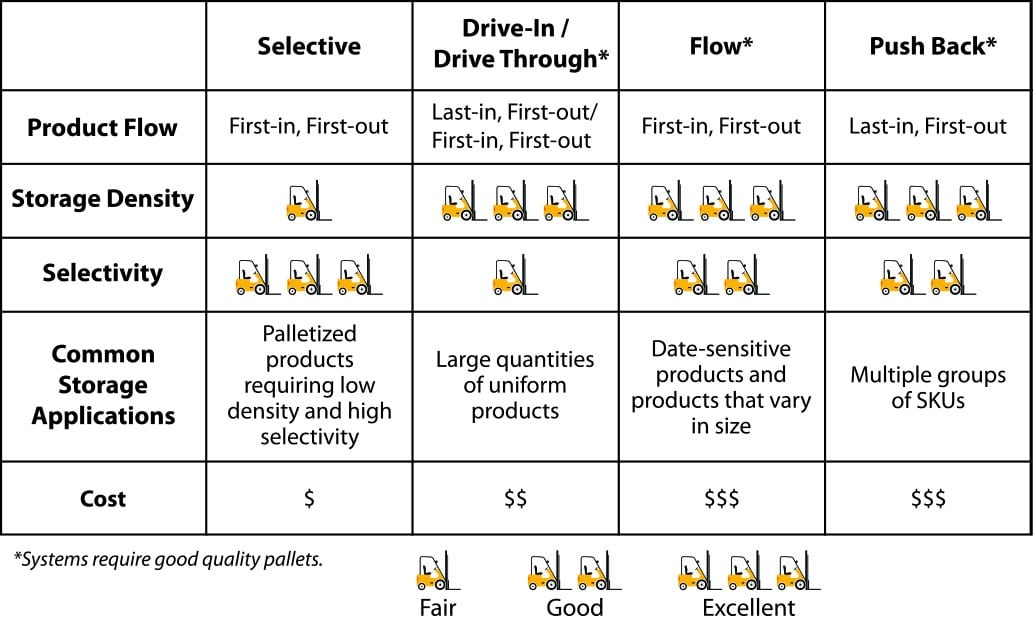
Selecting the appropriate racking system is the foundation of effective warehouse rack design. The choice depends on your inventory profile, throughput requirements, and available space. Each system offers distinct advantages and limitations that must align with your operational goals.
Selective Pallet Racking
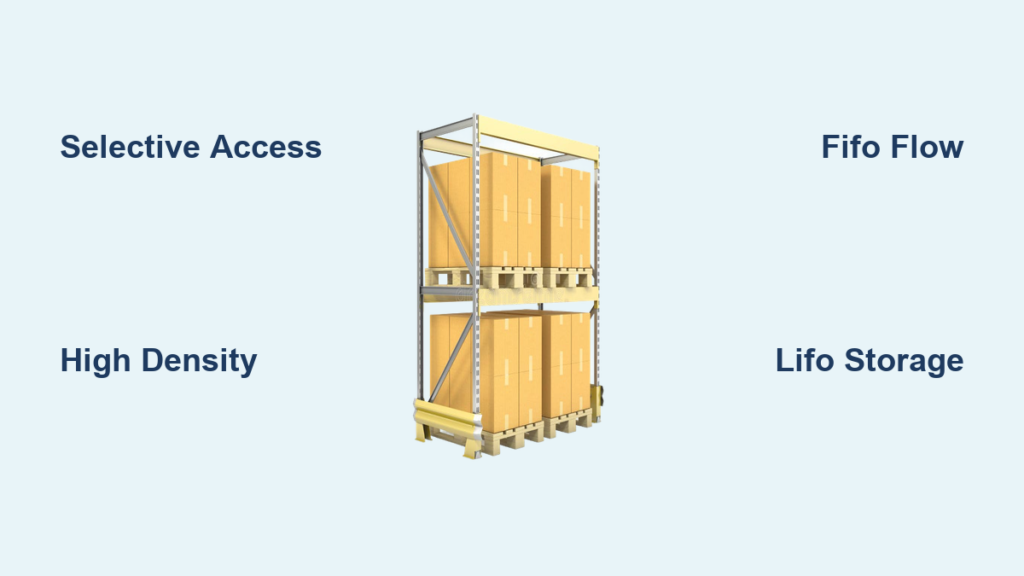
Selective pallet racking is the industry standard for high SKU variety and fast access. Vertical uprights connect with horizontal beams to form single deep bays where each pallet is directly accessible. This system uses standard counterbalanced forklifts and requires 11 to 13 foot aisles.
Key characteristics include:
• 100% selectivity for any pallet position
• Low to moderate storage density
• Ideal for distribution centers, 3PLs, and facilities with unpredictable demand
• Fastest access time compared to dense systems
Pro tip: Place fast moving SKUs at waist to shoulder height to reduce picker fatigue and speed up fulfillment. This simple slotting adjustment can improve order picking productivity significantly.
Double Deep Racking
Double deep racking stores two pallets deep using telescoping reach trucks, providing 20 to 35% more density than selective racking. The front pallet must be removed before accessing the rear one, which means this system follows LIFO rotation.
Best applications include:
• Cold storage facilities
• Seasonal inventory storage
• Operations with moderate SKU counts and stable demand
• Environments where space efficiency outweighs picking speed
Watch for: Reduced picking speed due to extended reach cycles. This system is not ideal for perishables or items with expiration dates.
Drive-In Racking
Drive-in racking maximizes cube in bulk storage environments where forklifts drive into the rack lane to store or retrieve pallets. Lanes can hold 10 or more pallets deep, but all pallets in a lane must share the same SKU.
Key specifications:
• Strict LIFO rotation
• Very high space efficiency
• Common forklift impact damage risk
• Best for homogeneous products like frozen foods, raw materials, and automotive parts
Critical safety note: Train operators rigorously and install column protectors at every aisle entry to prevent costly structural damage.
Drive-Thru Racking
Drive-thru racking operates like drive-in but with entry on one end and exit on the other, enabling FIFO rotation. This makes it perfect for date sensitive inventory like pharmaceuticals, dairy, and perishable goods.
Advantages include:
• Enforced FIFO compliance reduces spoilage
• High density with proper stock rotation
• Better for perishable goods than LIFO systems
Drawback: Higher engineering and maintenance costs due to reinforcement required at both entry and exit points.
Push-Back Racking
Push-back racking uses nested rolling carts on inclined rails. New loads push previous pallets backward while gravity returns them forward during retrieval. This system typically supports 2 to 6 pallets per lane without requiring forklift entry.
Operational benefits:
• Multiple SKUs can be stored per aisle
• Faster than drive-in systems
• No forklift entry reduces collision risk
• Moderate density with better selectivity than deep lane systems
Limitation: Requires uniform pallet sizes and weights for smooth cart operation. Not suitable for perishables due to LIFO rotation.
Pallet Flow Racking
Pallet flow racking is an automated FIFO system using gravity fed roller lanes from rear loading to front picking positions. Speed controllers prevent collisions and ensure consistent product flow.
Best use cases:
• Just-in-time manufacturing supply lines
• E-commerce fulfillment centers
• Food and beverage distribution
• High throughput operations requiring fresh stock rotation
Key requirement: Pallets must be uniform in size and condition to avoid jams. Rollers and brakes need regular maintenance checks.
Carton Flow Racking
Carton flow racking speeds up split case picking using skate wheels or mini-rollers for cartons and totes. This smaller version of pallet flow keeps fast movers at the pick face and enforces FIFO rotation.
Perfect applications:
• E-commerce order fulfillment
• Backroom restocking operations
• Service parts distribution
• High volume piece picking environments
Pro move: Pair with pick-to-light systems for zero error picking and maximum productivity.
Mobile Racking Systems
Mobile racking systems mount racks on motorized carriages that slide along floor tracks, opening aisles only when needed. This approach delivers up to 80% space savings in tight facilities.
Best for:
• Cold rooms and temperature controlled storage
• Archives and records management
• Luxury goods storage
• Urban warehouses where floor space is expensive
Requirements: Flat, level flooring and structural reinforcement. Throughput has slight delay when opening aisles.
Cantilever Racking
Cantilever racking handles long, bulky, or irregular items with arms extending from vertical columns. No front uprights block loading, making it ideal for lumber, pipes, furniture, and steel bars.
Configuration options:
• Single or double-sided designs
• Light, medium, and heavy-duty models
• Adjustable arm spacing for different load lengths
Design note: Arm spacing must match load center for stability and safe weight distribution.
Mezzanine Racking Systems
Mezzanine racking systems create double usable space without expanding the building through elevated steel platforms. These platforms can house racking, offices, or assembly zones.
Space gain:
• Up to 100% more functional area
• Integration with lifts, conveyors, or spiral chutes for vertical flow
Watch for: Building code compliance, fire suppression requirements, and floor load capacity assessments before installation.
Automated Racking Systems
Automated Storage and Retrieval Systems (AS/RS) use computer controlled stacker cranes while shuttle systems deploy autonomous vehicles inside racking lanes. These systems deliver high accuracy, lights-out operation, and significant space savings.
System types:
• Unit-load AS/RS for pallets
• Mini-load for totes
• Shuttle-based configurations
Best for: Cold storage facilities, high volume distribution centers, and automation ready warehouses. High upfront investment delivers strong ROI through labor reduction and density improvements.
Match Racking to Workflow Needs
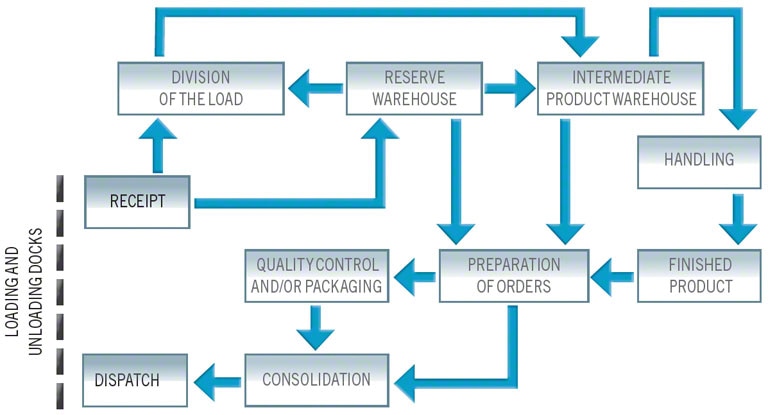
Your rack design for warehouse operations must start with understanding how inventory moves through your facility. The path from receiving to storage to picking to shipping should flow smoothly without cross traffic or backtracking.
Map Inventory Flow First
Place high turnover SKUs near outbound docks to minimize travel distance. Use ABC analysis where A-items representing top 20% of volume get prime real estate near picking zones.
Zone strategy:
• Fast-movers near front at ergonomic heights
• Slow-movers in deep-lane or remote areas
• Align racking rows parallel to dock doors
Align with Handling Equipment
Your forklift type dictates aisle width and rack compatibility. Counterbalanced forklifts require 11 to 13 foot aisles for selective racking while reach trucks operate in 8 to 10 foot aisles. Very narrow aisle (VNA) trucks work in 5 to 6 foot aisles for maximum density.
Automation consideration: Robotic systems need tighter tolerances and reinforced structures designed for precision, not just human operation.
Optimize for Product Characteristics
One-size rack does not fit all. Design around what you store by considering weight, dimensions, shape, and environmental requirements.
Key factors:
• Heavy loads need thicker uprights and stronger beams
• Adjust beam spacing to match pallet depth and height
• Irregular items require cantilever or custom solutions
• Cold storage applications benefit from closer rack spacing to reduce energy loss
Check floor load capacity: Consult an engineer if loads exceed 1,000 lbs per square foot.
Prioritize Worker Safety
Rack damage is a top OSHA violation. Follow RMI and OSHA standards by posting load capacity signs on every bay, installing column protectors and guardrails, and never allowing climbing on racks or walking on wire decks.
Required training:
• Safe forklift operation near racking
• Reporting dents, bends, or loose bolts immediately
• Emergency egress clearances
Audit quarterly: Walk aisles and inspect for damage to prevent catastrophic failures.
Factor in Facility Constraints
Measure everything before designing. Ceiling height determines rack height and cubic storage potential. Map obstructions including columns, ducts, and sprinklers early in the planning process.
Critical considerations:
• Seismic zone requirements need reinforced bracing
• NFPA requires 18 inch minimum clearance above highest stored item
• Cold storage applications benefit from grouped racks to reduce cooling load
Balance Cost vs. Performance

Initial price is not the full story when evaluating rack design for warehouse operations. Consider total cost of ownership including space savings, operational efficiency, and maintenance requirements.
Compare System Costs
Selective racking costs $50 to $150 per pallet position with the lowest upfront investment. Push-back systems run $200 to $400 while pallet flow reaches $300 to $600. Mobile racking costs $500 to $1,000 or more per position but delivers maximum density.
Rule of thumb: High-density systems save space cost per pallet, which is critical in expensive real estate markets.
Measure Operational Impact
Racking affects key metrics including order picking speed, labor costs, damage rates, and inventory carrying costs. Switching from selective to mobile racking in cold storage can cut energy costs by 30% due to reduced cubic volume requiring cooling.
Prepare for Automation and Growth
Building automation ready racks during initial design avoids costly retrofitting later. Focus on precision alignment with one-eighth inch tolerance for robotic access, reinforced frames for dynamic shuttle loads, and integrated sensors for real-time monitoring.
Adopt Emerging Trends
Consider Exotec Skypod systems using climbing robots on racks up to 39 feet tall for up to 5X density versus conventional racking. AI-driven slotting lets WMS learn which SKUs sell together and positions them nearby. Digital twin modeling simulates rack layout performance before installation to test congestion and throughput.
Action step: Run a digital twin of your proposed rack layout to avoid costly mistakes.
Use the Racking Selection Framework
Match system to need quickly using this decision checklist:
| Operational Need | Best Racking Choice |
|---|---|
| High selectivity, many SKUs | Selective |
| High density, few SKUs | Drive-In, Push-Back |
| FIFO required | Pallet Flow, Drive-Thru |
| LIFO acceptable | Push-Back, Double Deep |
| Perishable goods | Pallet Flow, Drive-Thru |
| Long/bulky items | Cantilever |
| Limited floor space | Mobile, Mezzanine |
| Cold storage | Drive-In, Push-Back, Mobile |
| Automation integration | Shuttle, AS/RS-Compatible |
| E-commerce fulfillment | Carton Flow, Selective, Skypod |
Finalize with Expert Input
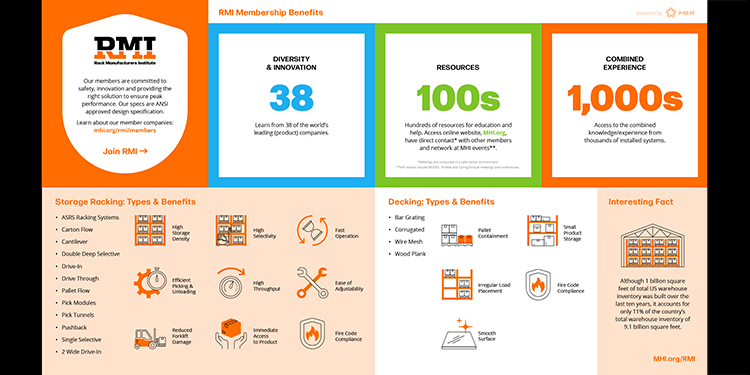
Do not go it alone. Engage RMI-certified rack manufacturers early in the planning process. They offer free layout consultations, engineering reviews for seismic and environmental loads, and compliance checks with OSHA and fire codes.
Resource: Visit mhi.org/rmi for standards, guides, and certified partners.
Key Takeaways for Smart Rack Design
- Start with workflow not cost or aesthetics. Map how inventory moves through your facility before selecting racking types.
- Match racking to product and turnover rate. High velocity SKUs need selective access while slow movers benefit from dense storage.
- Design for safety first. Protect people and inventory by following OSHA and RMI standards rigorously.
- Balance density and selectivity based on your specific SKU mix and access requirements.
- Plan for automation even if not implementing today. Build in precision and structural capacity for future robotic systems.
- Use expert engineering to avoid structural risks and ensure code compliance.
- Test with simulation before installation to validate throughput and identify congestion points.
A smart rack design for warehouse operations is not just about storing pallets. It is about building a faster, safer, and scalable operation that adapts to tomorrow’s demands today. Start with your workflow, match systems to your inventory profile, and plan for growth. The right racking configuration transforms your warehouse from a cost center into a competitive advantage.
Frequently Asked Questions About Rack Design for Warehouse
What is the most cost-effective racking system for a new warehouse?
Selective pallet racking offers the lowest initial investment at $50 to $150 per pallet position. It provides 100% selectivity and works with standard forklifts, making it ideal for facilities with high SKU variety and unpredictable demand patterns.
How do I choose between FIFO and LIFO racking systems?
Choose FIFO systems like pallet flow or drive-thru racking for perishable goods, pharmaceuticals, and products with expiration dates. Choose LIFO systems like push-back, double deep, or drive-in for non-perishable items where storage density is the primary concern.
What aisle width do I need for different forklift types?
Counterbalanced forklifts require 11 to 13 foot aisles. Reach trucks operate in 8 to 10 foot aisles. Very narrow aisle (VNA) trucks work in 5 to 6 foot aisles but require guided navigation systems.
Can I mix different racking types in one warehouse?
Yes, most warehouses use multiple racking types. Common combinations include selective racking for fast movers near picking zones, dense systems like drive-in for bulk storage, and carton flow for order fulfillment areas.
How much space can mobile racking systems save?
Mobile racking systems can save up to 80% of floor space compared to traditional selective racking by eliminating fixed aisles. This makes them ideal for cold storage, archives, and urban warehouses where floor space is expensive.
What safety standards apply to warehouse racking?
Warehouse racking must comply with OSHA regulations and Rack Manufacturers Institute (RMI) standards. Requirements include posted load capacity signs, column protectors, guardrails, proper aisle clearance for emergency egress, and regular damage inspections.